Be yourself; Everyone else is already taken.
— Oscar Wilde.
This is the first post on my new blog. I’m just getting this new blog going, so stay tuned for more. Subscribe below to get notified when I post new updates.
Be yourself; Everyone else is already taken.
— Oscar Wilde.
This is the first post on my new blog. I’m just getting this new blog going, so stay tuned for more. Subscribe below to get notified when I post new updates.
Venezuela, a country in South-America, it has the world’s largest oil reserves and has been exporting oil to American countries. The economy of venezuela is largely based on petroleum and manufacturing, it is the sixth largest member of OPEC.
During the 1950s Venezuela was a country that had very high standard of living, from that to now, where the citizens of Venezuela are suffering to even receive basic amenities is an example of shakedown economy. If compared to other economic crisis, the venezuela crisis is worse than the condition of the united states during the great depression or the condition of russia during the economic crisis. Venezuela is undergoing hyperinflation from a very long time, the economic condition of the country has gone downhill after the oil crisis in the 1980s. Venezuela is one of the countries that has had a very high ranking in the misery index from 2013. Presently 90% of the population is hit by poverty, the living conditions are poor and there is a shortage of basic necessities and medical equipment.
History-
Oil was found in the 1920s in Venezuela, after which the production of oil rose and Venezuela became one of the strongest countries in south America, it had a flourishing economy. It formed an international oil cartel and had considerable growth in the GDP.
After the oil crisis in the 1980s, Venezuela witnessed an economy slowdown, it was marked by high inflation rates and the GDP decreased and became negative. After the incorporation of liberalisation policies, the GDP shot up again to 9.2% in 1991, but the inflation remained high and went up to 100% in the year 1996, this was the highest inflation rate the country had witnessed, high inflation rates were accompanied by high poverty rates and the living conditions deteriorated.In the year 1999, Hugo Chavez was elected as the president of Venezuela, he proposed social and political economic policies, it means he promoted the idea that economic policies can change the course of society and lead to social justice and equity.
In 2013, Nicolas Maduro was chosen as the successor of Hugo Chavez and was elected to be the president, Venezuela went into an economic recession from 2014 and the GDP declined, the condition has become worse ever since.
The Dutch Disease-
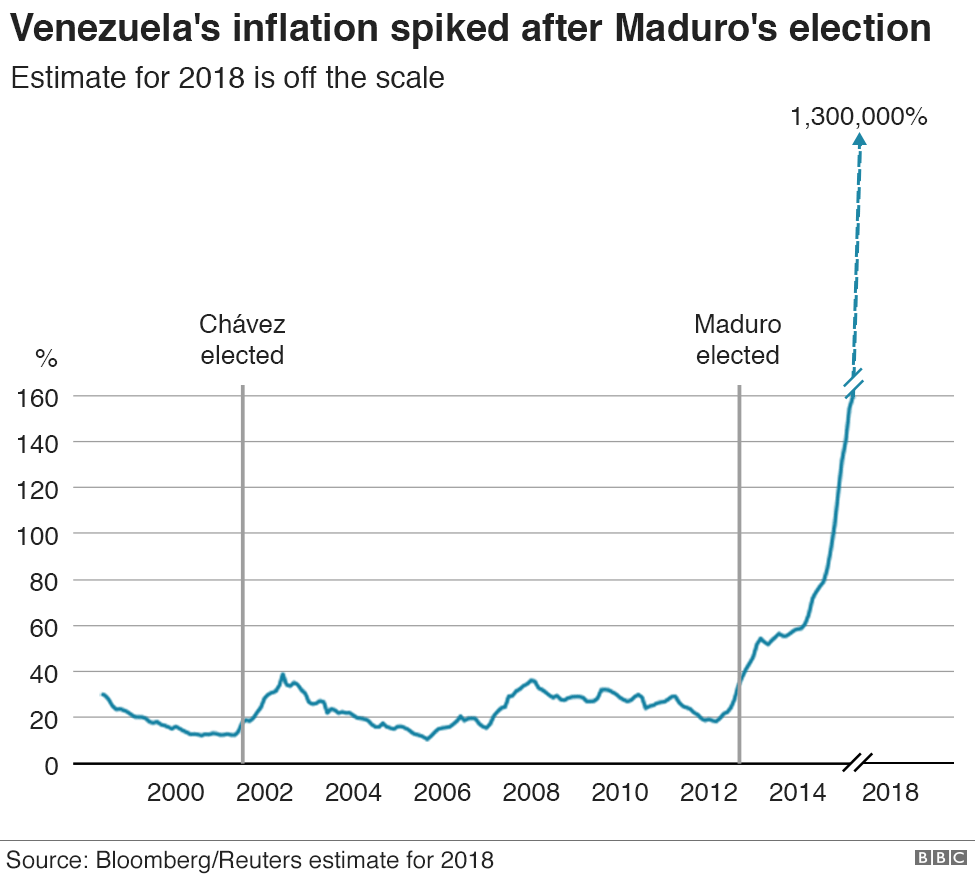
Venezuela is a country that has always been depended on its natural resources, most of the revenue generated by the government is through export of oil, it implies that the country was hugely depended on its exports due to its high dependency on only one sector of the economy, the Venezuela government concentrated most of its resources to the extraction and export of oil and as a consequence of this the other sectors of the economy suffered and the production in the manufacturing and agriculture sector was low. Abundant availability of a resource leads to inflow of foreign capital because of which there is an appreciation in the local currency and imports increase as they become comparatively cheaper, because of this the government takes away labour from other sectors and employs them in the export industries, this leads to unhealthy dependency on the export industries. In case there is turmoil in the industry of the natural resource that is being exported, then the country dependent on that natural resource will undergo an economic crisis. Petrostates are small countries that have large oil reserves and are highly dependent on the export of its oil as it is the means through which high revenue can be generated. Venezuela was vulnerable to the fall in the oil prices and was majorly affected by the oil crisis as it was dependent on the extraction and export of oil. Fall in oil prices lead to venezuela having surplus oil stocks, however it does not necessarily mean that there would be political and domestic stability, the surplus was rather a liability for the country. Venezuela, being a petrostate, was highly vulnerable to the downfall in prices of oil and thus, was a major victim to it as the country essentially depends on the trade of that resource. Oil being the most important and widely exported resource in venezuela, makes the country prone to a disease called the “dutch disease”. This disease affects the country, making the oil refineries a curse this is also called the ‘resource curse’. Similarly in a business, an entrepreneur must not invest all his capital into one business but rather expand his business into multiple sectors and that way if there is a downfall in one particular sector of the economy, the entrepreneur will not fall into a complete loss. The oil curse can be avoided if the revenue generated form its production and export can be used in a responsible way, especially for under developed or developing countries, if they earn revenue from the export of a natural resource then they must use the revenue in developing the infrastructure and invest on the healthcare and education sector and work on creating more jobs for the people, which would lead to increase in employment and income. This would lead to increase in GPD and growth of the economy, that would lead to the development of the country. High Inflation rate has persisted in venezuela from 1980s, the rate reduced during the period of chavez from 2006-2012 and it again hiked up in 2013, when Maduro got elected. After 2013, the condition of venezuela has worsened and the inflation rates been been exceedingly high. The production of oil has also been reducing since 2013 and it is falling in milions of barrels per day.
Causes-
The cause of such hyperinflation is not efficient macro economic policies, it not only lead to hyperinflation but also drained the foreign exchange reserves. The economy worsed when the currency of the country devalued multiple times. After Mudrao’s presidency there was a fall in the wages, to resolve this Mudrao increased the wages, economists believed that this measure would only resolve the problem temporarily, as the inflation rates were very high. Increasing the wages were a burden for the companies, as companies were already facing a shortage of currency, so in this period it was very difficult to pay wages. The citizens of Venezuela blame Chaves and Maduro for the terrible condition of the country, they believe that due to the socialist policies the economy of the country detoriated, for example Chaves implemented price control but it misfired when due to the price control on basic good, the producers of these products found it non-profitable to produce so the production of necessary goods reduced. Venezuelans are suffering as they cannot afford to buy basic goods and the purchasing power of the citizens are extremely low.
Political Situation-
Maduro was elected in 2013 after the death of Chavez, Maduro won the elections with a thin margin. Maduro was elected again his second term, but there are allegations that the elections were not fair, this election was boycotted by the opposition parties and people did not accept Maduro as their president. As the election results were not widely accepted by people, therefore the position of the president remained vacant and according to the constituition of venezuela, the head of the National Assembly would become the president if that position is vacant, therefore Juan Guaido declared himself as the president of Venezuela, now he is recognised as the president by other countries, including countires in latin america.
Because of the condition of the country, many citizens migrated to other countries, mostly to argentina, chile, brazil, united states and spain.
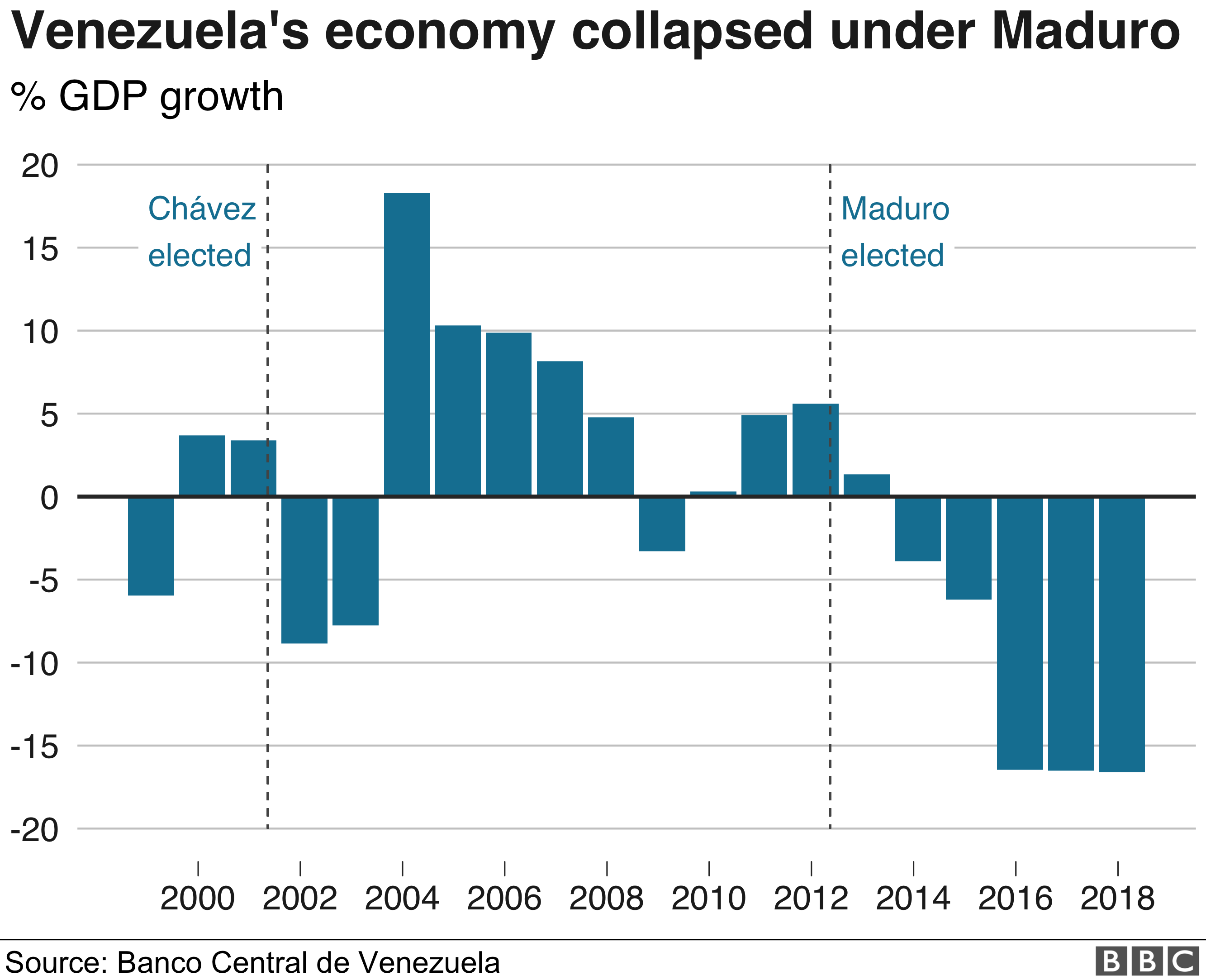
| YEAR | GDP in percentage |
| 2000 | 3.687 |
| 2001 | 3.394 |
| 2002 | -8.856 |
| 2003 | -7.755 |
| 2004 | 18.287 |
| 2005 | 10.318 |
| 2006 | 9.872 |
| 2007 | 8.754 |
| 2008 | 5.278 |
| 2009 | -3.202 |
| 2010 | -1.489 |
| 2011 | 4.176 |
| 2012 | 5.626 |
| 2013 | 1.343 |
| 2014 | -4 |
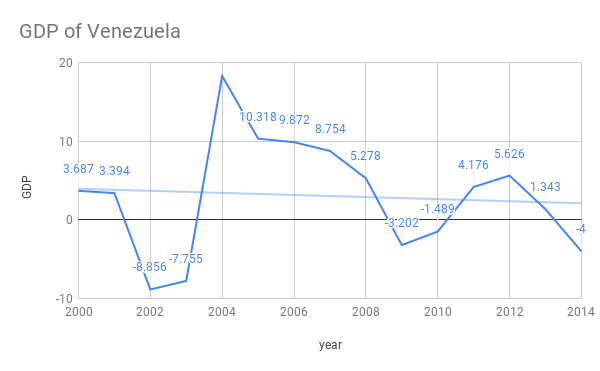
| Year | Inflation Rate |
| 2000 | 13 |
| 2001 | 12.3 |
| 2002 | 31.2 |
| 2003 | 31.1 |
| 2004 | 22.4 |
| 2005 | 16 |
| 2006 | 15.8 |
| 2007 | 18.7 |
| 2008 | 30.4 |
| 2009 | 27.1 |
| 2010 | 29.8 |
| 2011 | 26.1 |
| 2012 | 21.1 |
| 2013 | 56.2 |
| 2016 | 720 |
| 2017 | 652.7 |
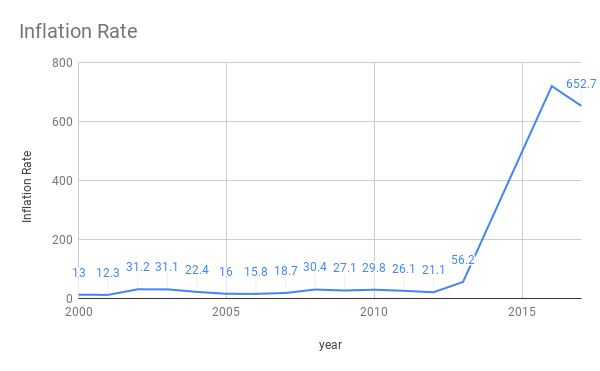
The GDP of Venezuela has been fluctuating since 2000 and has detoriated from 2014 and has become negative. We can notice a relation between the GDP and the inflation rate.
The inflation rate has constant increased and has become very high after 2013, after 2013 venezuela experienced hyperinflation and now the condition has become worse and the inflation rate in 2018 was 1,000,000 percent, this is the worst hyperinflationary crisis in modern history. The GDP is falling along with the increase in inflation.Hyperinflation in Venezeula
REFERENCES
Team, T. V. (2019, February 04). Venezuela: All you need to know about the crisis in nine charts. Retrieved from https://www.bbc.com/news/world-latin-america-46999668
Venezuela Real GDP Growth [1998 – 2019] [Data & Charts]. (n.d.). Retrieved from
https://www.ceicdata.com/en/indicator/venezuela/real-gdp-growth
Venezuela GDP Annual Growth Rate. (n.d.). Retrieved from
https://tradingeconomics.com/venezuela/gdp-growth-annual
This is an example post, originally published as part of Blogging University. Enroll in one of our ten programs, and start your blog right.
You’re going to publish a post today. Don’t worry about how your blog looks. Don’t worry if you haven’t given it a name yet, or you’re feeling overwhelmed. Just click the “New Post” button, and tell us why you’re here.
Why do this?
The post can be short or long, a personal intro to your life or a bloggy mission statement, a manifesto for the future or a simple outline of your the types of things you hope to publish.
To help you get started, here are a few questions:
You’re not locked into any of this; one of the wonderful things about blogs is how they constantly evolve as we learn, grow, and interact with one another — but it’s good to know where and why you started, and articulating your goals may just give you a few other post ideas.
Can’t think how to get started? Just write the first thing that pops into your head. Anne Lamott, author of a book on writing we love, says that you need to give yourself permission to write a “crappy first draft”. Anne makes a great point — just start writing, and worry about editing it later.
When you’re ready to publish, give your post three to five tags that describe your blog’s focus — writing, photography, fiction, parenting, food, cars, movies, sports, whatever. These tags will help others who care about your topics find you in the Reader. Make sure one of the tags is “zerotohero,” so other new bloggers can find you, too.

 Economically Woke